Audience
AI for nursing students: the tools, prompts and safety rules that fit a clinical timetable
Updated 1 June 2026 · 11 min read
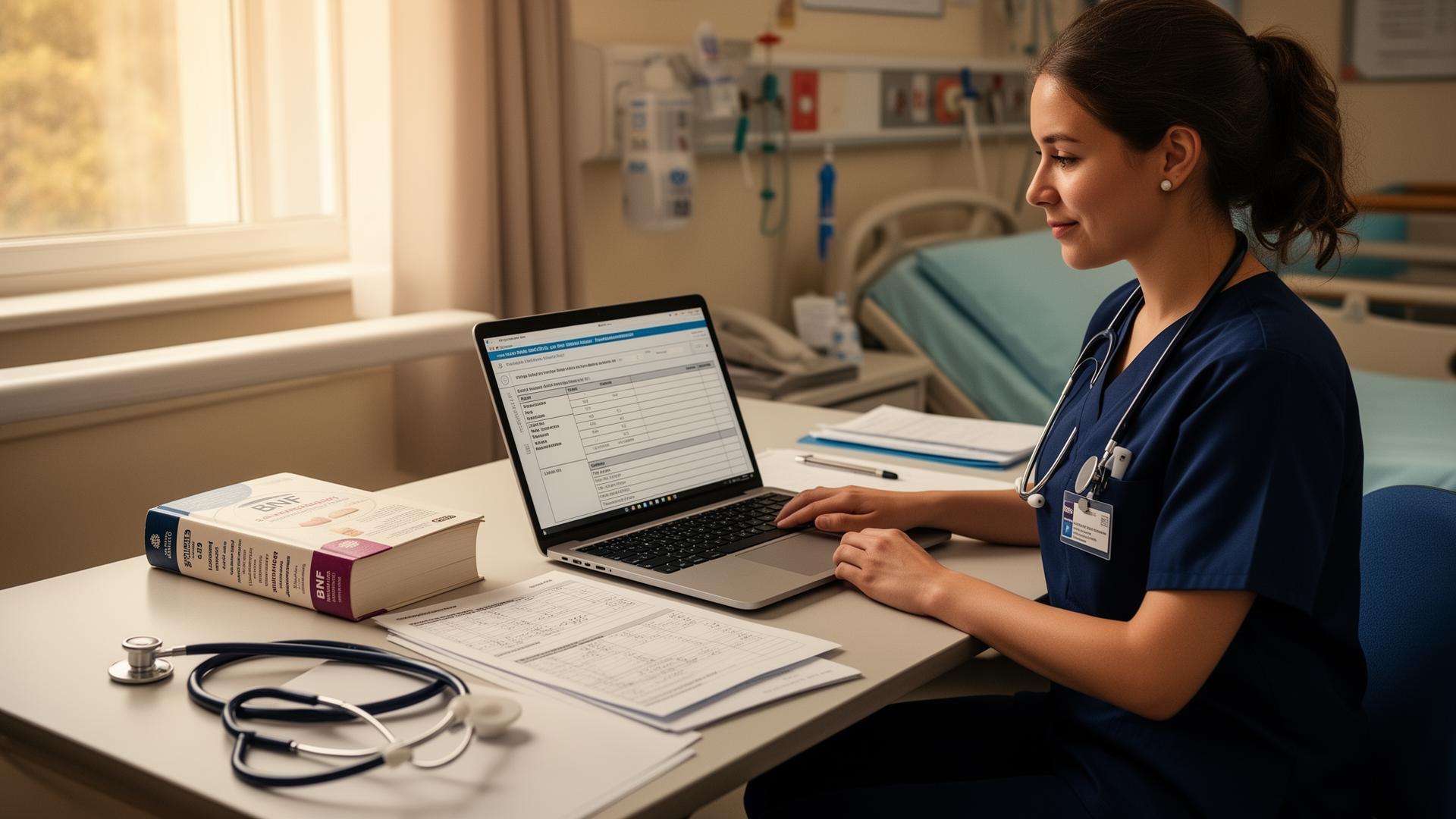
AI for nursing students is most useful as a drug-calculation drill, a care-plan drafter, an SBAR rehearsal partner and an OSCE simulator. Used inside those four jobs, free tools like ChatGPT, Claude, NotebookLM and Anki cut revision time roughly in half. Used for clinical decision-making, drug dosing without a formulary check, or anything involving patient-identifiable data, the same tools cross safety lines that matter more in nursing than in any other discipline. This guide is the working stack, the prompts that earn their place, and the cross-checks the NMC expects you to do anyway.
How to think about AI in a nursing programme
Nursing programmes balance theory and placement in a way medical school does not. The AI tools that pay off reflect that split. Less essay writing, more care planning, drug-calc practice and OSCA or OSCE simulation. The Nursing and Midwifery Council's 2024 guidance on generative AI is straightforward: AI may support your learning, but you remain personally accountable for every decision, every dose and every entry under your name. That single sentence dictates the entire workflow below.
The mental model that works: treat AI as a fast first draft, never as the final answer. It writes a care plan structure in 30 seconds that would have taken an hour. You then read every line, verify every dose, and own every word before it goes near a patient or an assessor. The time saved goes back into placement, sleep, and the only thing that actually grows a nurse: practice on real wards.
The five highest-value uses for nursing students
1. Drug-calculation drills
Ask ChatGPT or Claude to generate 10 drug-calculation questions at your year group: IV infusion rates, paediatric weight-based doses, drip rates, fluid balance. Specify your country (units differ between the UK, US and Australia), then ask the model to mark your working step by step. The drill is excellent. The answers are not authoritative. A 2024 BMJ Open analysis of ChatGPT-4 on paediatric prescribing found a clinically significant error rate above 25 percent on weight-based doses, so verify everything against the BNF, BNFc or your local formulary.
2. Care plans and SBAR rehearsal
Paste an anonymised scenario, name your framework (NANDA, Roper-Logan-Tierney, ADPIE, Orem), and ask for a structured care plan. Then ask for an SBAR handover script for the same patient. The model is excellent at the scaffolding and mediocre at the nuance. Use the structure, rewrite the clinical reasoning in your own words. Submitting unedited AI text as coursework is academic misconduct at every UK and US nursing school as of 2026.
3. OSCA and OSCE patient simulation
Claude Sonnet 4.5 is the best at playing a simulated patient who is not immediately forthcoming. Give it the scenario, instruct it to answer only what is asked, and run your history station against it. The model holds character across long conversations and surfaces realistic ICE concerns (ideas, concerns, expectations) without volunteering them. Same workflow detailed in the chatgpt-for-medical-students guide.
4. Anatomy, equipment and dressing diagrams
Nursing curricula are visually heavy on systems, wound care, equipment setup and pathophysiology. Sketch-first AI illustration tools turn a rough sketch into a clean labelled diagram in under a minute. Generic text-to-image models like DALL-E 3 and Midjourney still hallucinate anatomy and equipment, so for anything testable use a sketch-first tool such as Angiosome, which renders from your topology rather than inventing one. Print into your notes or drop into Anki for image-occlusion review.
5. Lecture summarisation and study guides
NotebookLM is built for this. Upload your lecture slides, recorded transcripts and chapter PDFs as sources. Every answer it gives cites the exact source paragraph, so hallucinated facts have nowhere to hide. The free tier handles up to 50 sources per notebook and one million tokens of context, which covers an entire module without trimming.
The free stack that covers a full academic year
Most nursing students never need to pay for an AI subscription. The combination below covers explanation, summarisation, drilling and review, and runs entirely on free tiers.
| Tool | Job to be done | Free tier | Paid only if |
|---|---|---|---|
| ChatGPT (GPT-5) | Explanations, drug-calc drills, SBAR rehearsal | Yes, daily limit | You generate 50+ cards a day, then Plus at £16/mo |
| Claude Sonnet 4.5 | OSCE simulation, care-plan drafts | Yes, daily limit | Long projects, then Pro at £15/mo |
| NotebookLM | Source-grounded module summaries | Yes, 50 sources, 1M tokens | Plus tier $19.99/mo (rarely needed) |
| Anki + AnkiDroid | Spaced-repetition memorisation | Free on desktop, web, Android | Only iOS, $24.99 one-off |
| Angiosome | Anatomy and equipment diagrams | Limited free renders | If you produce diagrams weekly |
Where nursing has higher AI-safety stakes than medicine
Nurses administer the dose. That single fact raises the safety bar above where it sits for medical students who are usually one step removed from the syringe. Four risks deserve hard rules, not soft warnings.
| Risk | Hard rule | Source |
|---|---|---|
| Drug doses | Always cross-check AI answers against BNF, BNFc or local formulary | NMC Code 2018, section 6 |
| Patient-identifiable data | Never paste real names, MRNs, DOBs or rare features into cloud AI | NHS England IG Framework 2024 |
| Clinical decision support | Use only tools licensed for your scope; never extrapolate | MHRA Software as Medical Device 2023 |
| AI-drafted documentation | Read every line; never auto-sign; check trust policy first | NMC Record-keeping guidance 2023 |
Prompts worth saving for the year
- 'Generate 10 weight-based paediatric paracetamol calculations at NMC year 2 level. Mark my answer step by step. UK doses, BNFc reference.'
- 'I am rehearsing an SBAR handover. The patient is [anonymised scenario]. Tell me when my handover is missing the assessment or recommendation, and rate it 1 to 5.'
- 'You are a patient on a respiratory ward who is anxious about going home alone. You will not volunteer your worry unless I ask the right open question. Begin.'
- 'Explain the pathophysiology of [condition] for a second-year nursing student in three paragraphs, then one analogy, then one sentence I could use to explain it to a patient.'
- 'Draft an ADPIE care plan for an anonymised post-op patient with this clinical picture: [paste]. Flag any nursing diagnosis where you are uncertain.'
A realistic week using the stack
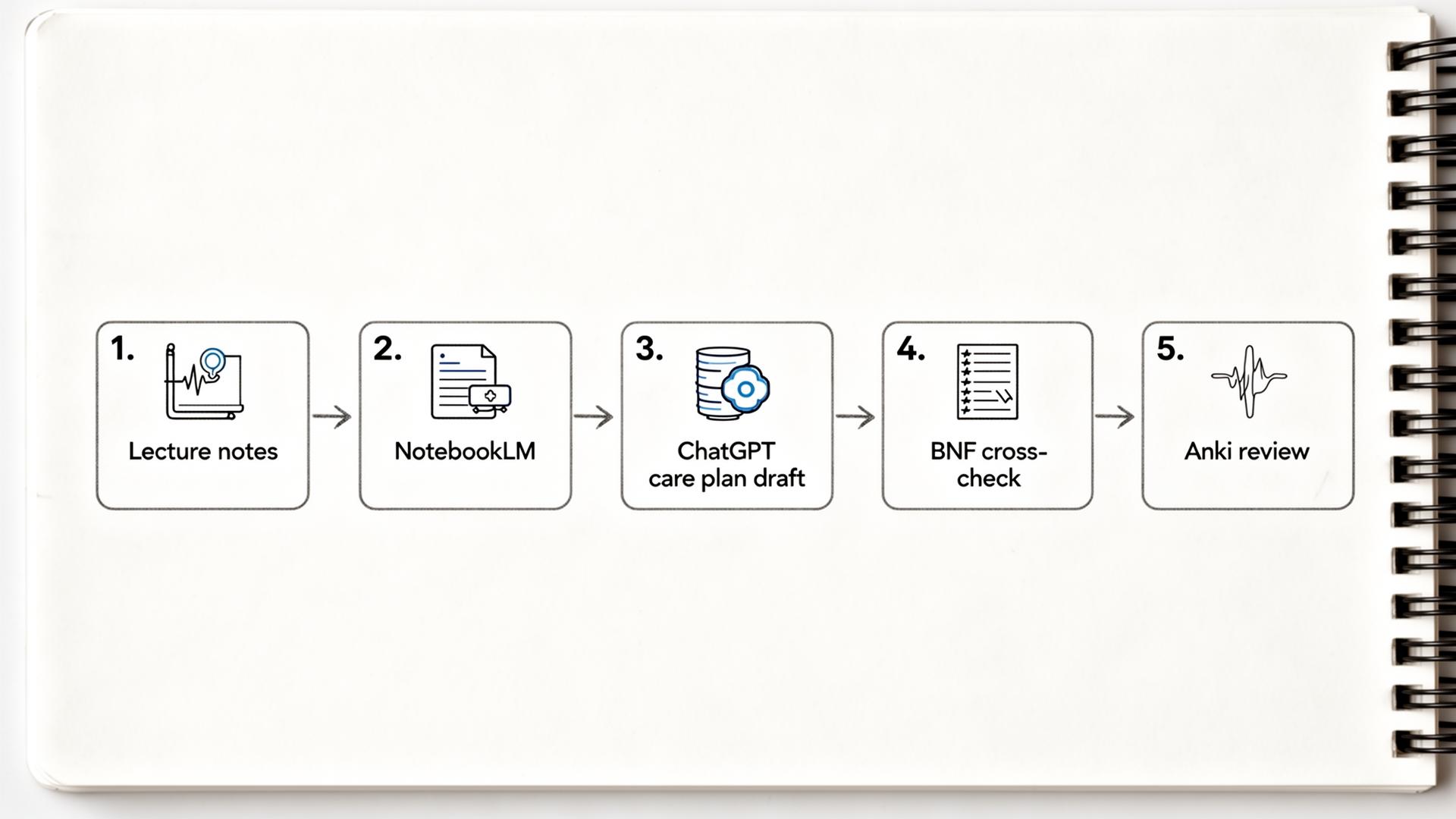
Monday lecture on diabetes management: record (with consent), drop the audio into MacWhisper or Otter.ai for a transcript, paste transcript into NotebookLM with your slide PDF, ask for a study guide. Tuesday placement reflection: anonymise the case, ask Claude for a Gibbs reflective cycle scaffold, rewrite in your own voice. Wednesday drug-calc practice: ChatGPT drills, BNFc cross-check, Anki cards for the ones you got wrong. Thursday OSCE prep: Claude as a simulated patient, 20 minutes per station. Friday: 15-minute Anki review across the week. Total AI time, roughly two hours. Time saved, closer to ten.
AI scribes and clinical AI tools on placement
AI scribes for clinical documentation are appearing in NHS trusts and US health systems. The 2024 Permanente Medical Group rollout of ambient AI scribes covered over 3,400 physicians and was associated with reduced documentation burden, but the evidence base for nursing notes specifically is much thinner. If your trust pilots a scribe, use it within the policy. If not, leave clinical-AI tools alone until your scope is documented in writing. Personal study tools used in your own time sit in a completely different category and need no permission.
Nursing-branded AI apps (Picmonic AI, NurseAI, several others on the App Store) are mostly wrappers over GPT-5 or Claude with a nursing prompt baked in. They are convenient, rarely better, and sometimes worse because the wrapper limits what you can ask. For most students the honest recommendation is to save the subscription and prompt ChatGPT well.
Sources
- Nursing and Midwifery Council — The Code (2018, updated 2024)
- NMC — Position statement on generative AI in education and practice (2024)
- BNFc — Paediatric drug dosing reference
- Tierney AA et al. — Ambient AI scribes and physician documentation burden (NEJM Catalyst, 2024)
- MHRA — Software and AI as a Medical Device
- NHS England — Information Governance Framework
- Google — NotebookLM product page and limits
- Anki Manual — getting started
Frequently asked questions
What is the best AI for nursing students?
ChatGPT (GPT-5) and Claude Sonnet 4.5 are the strongest general tools, with NotebookLM for source-grounded study and Anki for memorisation. Pair every drug answer with a BNF or BNFc cross-check. Nursing-branded AI apps are mostly wrappers over the same models and rarely justify their subscription cost for an individual student.
How much does AI cost for nursing students?
Most students run the full workflow free. ChatGPT, Claude, Gemini and NotebookLM all have generous free tiers; Anki is free on desktop, web and Android; AnkiMobile on iOS is a one-off $24.99 purchase. Paid tiers (ChatGPT Plus £16/month, Claude Pro £15/month) become worth it only if you generate AI content daily across long contexts.
Is AI safe for drug calculations in nursing?
Safe for practice drills, unsafe for live patient care without verification. A 2024 BMJ Open analysis found GPT-4 produced clinically significant errors on more than 25 percent of paediatric weight-based doses. Use AI to generate practice questions and mark your working, then always cross-check the answer against the BNF, BNFc or your local formulary before trusting any number.
Can AI help with care plans without being academic misconduct?
Yes, if you use AI for the structural scaffold and write the clinical reasoning yourself. UK and US nursing schools in 2026 treat unedited AI submissions as plagiarism, but using AI to draft an ADPIE skeleton you then rewrite is broadly accepted under university generative-AI policies. Check your own institution's wording before each submission.
Can I use AI on clinical placement?
Personal study tools in your own time are fine and need no permission. Patient-facing tools, AI scribes, or anything involving identifiable data require an explicit trust policy and supervisor sign-off. Pasting any real patient detail into a consumer chatbot like ChatGPT breaches NMC confidentiality guidance regardless of whether the patient is harmed, so default to a hard no.
Will my nursing school catch me using AI?
Turnitin's AI detector and similar tools are increasingly used across UK and US nursing programmes from 2024 onwards. Submitting raw AI text in reflections, care plans or essays is detectable and treated as academic misconduct. Using AI to draft a structure you then rewrite in your own voice, with your own clinical reasoning, is both legitimate and undetectable.
Is ChatGPT better than a nursing-specific AI app?
For most students, yes. Apps like Picmonic AI and NurseAI are usually thin wrappers over GPT-5 or Claude with a fixed system prompt that limits what you can ask. A well-prompted ChatGPT free tier matches or beats them on flexibility for explanation, drug-calc drills and OSCE practice, and costs nothing.
What is the best AI tool for OSCE practice as a nursing student?
Claude Sonnet 4.5 is currently the strongest simulated-patient model because it holds character across long conversations and only volunteers information when asked. Give it the scenario, instruct it to answer only what is asked, and run timed stations against it. ChatGPT works too but drifts out of character faster on longer histories.
Try it
Sketch it. Angiosome renders it.
Angiosome turns rough medical sketches into clean, labelled, photoreal diagrams — grounded in your sketch, not invented by a model. Free to try.
Open Angiosome →Keep reading
Pillar
AI for Medical Students: 2026 Playbook
Pillar
Best AI Tools for Medical School (2026, Ranked)
Tool deep-dive
ChatGPT for Medical Students: 2026 Playbook
Tool deep-dive
NotebookLM for Medical School: 2026 Guide
Tool deep-dive
Anki + AI Flashcards: Med School Workflow
How-to
How to Make Anatomy Diagrams with AI (2026)