Pillar
AI for medical students: the tools, prompts, and workflows that actually save time in 2026
Updated 1 June 2026 · 12 min read
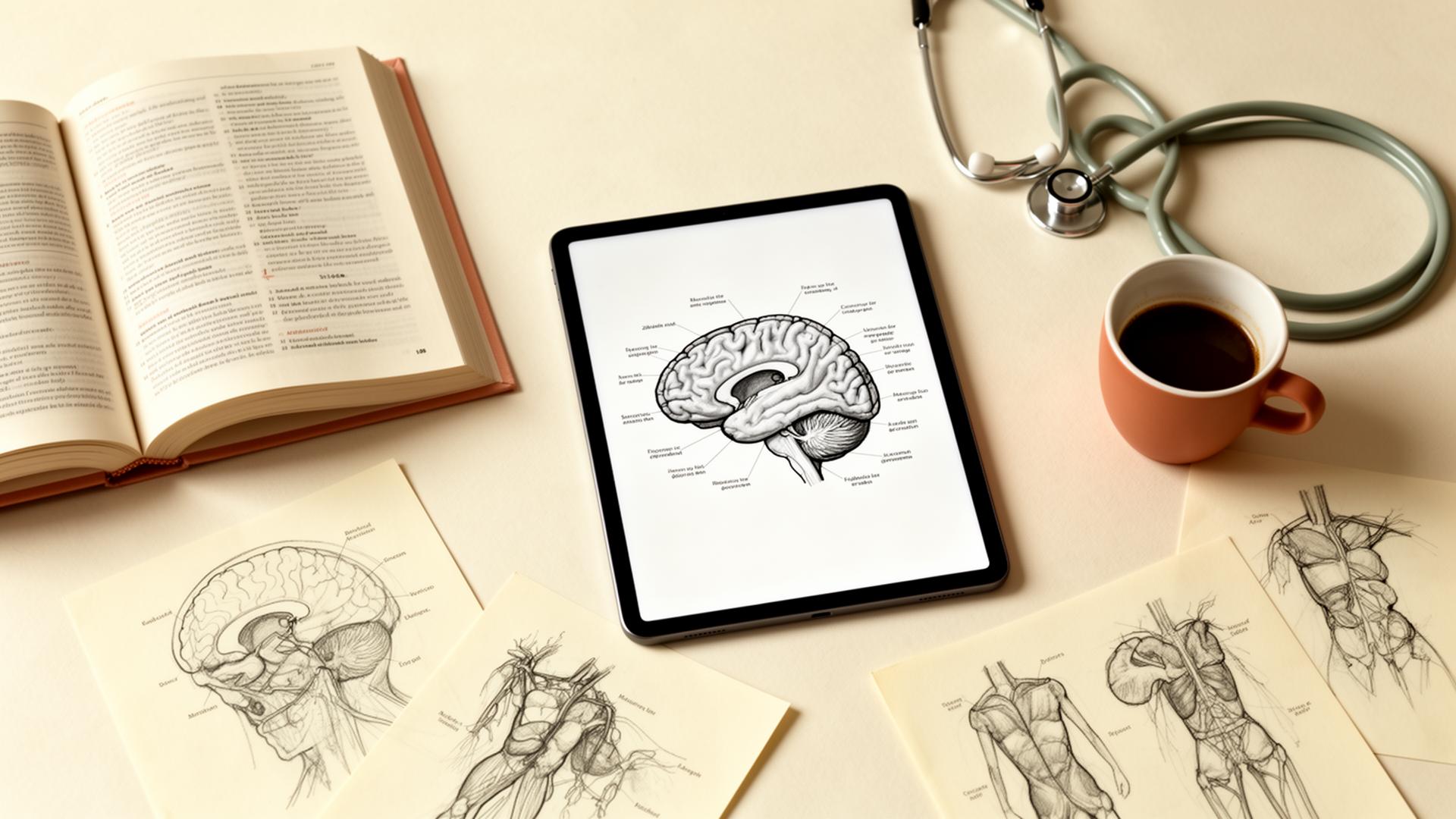
AI for medical students is, in 2026, the single biggest unfair advantage in the library. Used well, it compresses a four-hour study block into ninety minutes; used badly, it teaches you confidently wrong anatomy and gets you flagged for academic misconduct. This guide is organised around the four jobs you actually do every week — understand, memorise, visualise, present — and recommends the specific tools that earn their place in each loop, with prompts, prices, and the honest limits worth respecting.
How to think about AI in medical school
Medical school is a memory problem wrapped in a comprehension problem. AI helps with both, but in different ways. For comprehension, large general models like ChatGPT, Claude, and Gemini are extraordinary tutors: patient, infinitely available, and good at re-explaining the same concept eight ways until one sticks. For memory, generic models are mediocre on their own; you want spaced repetition, and AI's role is to generate good cards from your notes, not to replace the review itself. For visual learning, neither chatbots nor flashcard apps are enough. Diagrams are where most AI tools are weakest, and where a purpose-built tool earns a place on your home screen.
The mental model that works: treat AI as a translator between formats. It is best when it converts one form of understanding into another — text into a diagram, a lecture into flashcards, a paragraph into a mnemonic. It is worst when you ask it to skip the understanding step entirely. A model that writes your essay produces something graded; a model that re-explains a concept produces a doctor.
The four loops worth automating
1. The 'I don't understand this' loop
When a textbook paragraph doesn't make sense, paste it into ChatGPT or Claude and ask for three explanations: one for a first-year, one analogy from outside medicine, and one with the clinical relevance up front. This is the single highest-value prompt in medical school. You're not asking the model to know the answer — the textbook already knows. You're asking it to re-package an explanation until your brain finds a handle.
2. The 'I need to remember this' loop
Generic AI is bad at this on its own. Pair it with Anki. Take a chunk of notes, hand it to ChatGPT with a card-style prompt ('produce cloze deletions, one fact per card, no compound facts, atomic enough to recall in eight seconds'), import the output to Anki, review forever. A 2008 randomised study by Karpicke and Roediger published in Science found that testing yourself outperforms re-reading by a factor of roughly two for long-term retention. The model writes the cards; the recall is what does the work. The deep dive sits in our anki-ai-workflow guide.
3. The 'I need to see this' loop
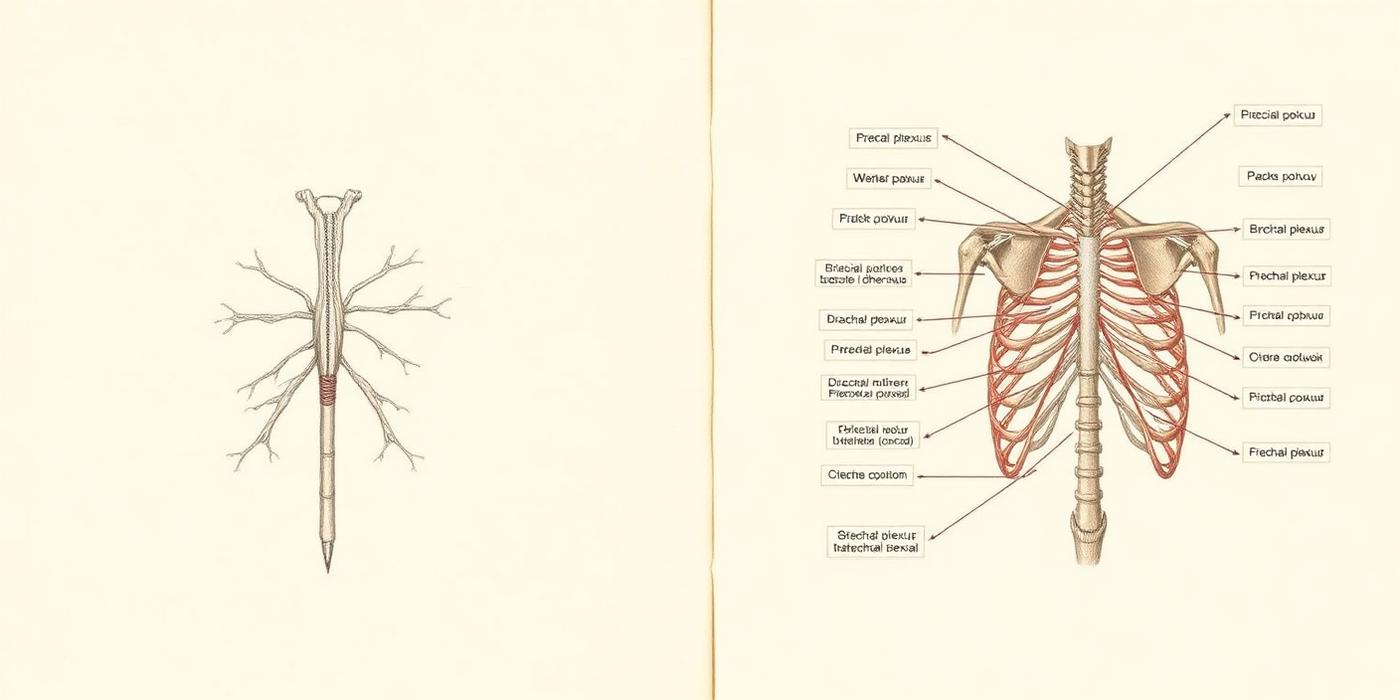
When a structure is verbal in your notes but visual on the exam, you need a diagram. Asking ChatGPT or Midjourney to 'draw the brachial plexus' produces an image that looks fine and is anatomically wrong — the model hallucinates branches, mirrors arms, and invents nerves that don't exist. For anatomy, surgical planning, and any structure you'll be tested on, use a tool that's been built for it. Angiosome is one: you sketch the structure roughly, the model returns a clean labelled photoreal version grounded in your sketch instead of inventing the topology. The full workflow lives in the how-to-make-anatomy-diagrams-with-ai guide.
4. The 'I'm presenting on Friday' loop
Case presentations, journal clubs and grand rounds eat hours that could be spent revising. Gamma, Beautiful.ai, and Canva's AI presentation features turn an outline into slides in minutes. Quality varies by topic — they're great for structure, mediocre for medical imagery. Generate the slides, then replace the stock images with ones you trust: BMJ Best Practice, Radiopaedia, your own labelled diagrams. The slide structure is the slow part; the AI handles it, you keep the medicine.
AI tools for medical school, by job-to-be-done
| Task | Best tool (2026) | Free tier | Why |
|---|---|---|---|
| Re-explain a hard concept | ChatGPT or Claude | Yes | Patient, multi-angle, free tier is enough for most students |
| Summarise a lecture PDF | NotebookLM | Yes (Google account) | Stays grounded in the source you upload and cites it back |
| Generate flashcards from notes | ChatGPT + Anki | Yes | Model writes the cards, Anki schedules the reviews |
| Draw labelled anatomy diagrams | Angiosome | Yes | Sketch in, photoreal labelled image out — anatomically faithful |
| Make case-presentation slides | Gamma | Yes (up to 400 credits) | Outline-to-deck in one prompt; export to PowerPoint |
| Find a real cited paper | Consensus or Elicit | Yes | Returns real DOIs, not invented citations |
| Translate a long guideline | Claude (200k context) | Yes | Long context window, careful with clinical nuance |
| OSCE patient simulation | ChatGPT (voice mode) | Free with limits | Plays a vague, realistic patient if you prompt it correctly |
Prompts that actually work
Most 'AI for med school' content tells you to use ChatGPT and stops there. The prompt is where the leverage lives. These four templates cover roughly 80% of what a clinical student does in a week.
The Feynman prompt (for understanding)
The flashcard prompt (for memorising)
The OSCE prompt (for practising stations)
The differential prompt (for clinical reasoning)
Things AI is still bad at (don't fight it)
- Naming nerves, branches and arterial supplies correctly from a text description alone. It will sound confident and be wrong.
- Drug doses. Always verify against the BNF, Lexicomp, or your local formulary — never trust a model's number for a prescription.
- Recent guideline changes. Most models have a knowledge cutoff months behind the latest NICE, AHA or BTS update.
- Differential reasoning under genuine uncertainty. It's a useful second opinion, never a first one. You are the clinician in training.
- Image generation of accurate medical illustrations. Use a tool built for it (see our ai-medical-illustration guide).
- Citing real papers. ChatGPT will fabricate plausible-looking DOIs. Use Consensus, Elicit, or Scite for any reference that will end up in a portfolio.
A weekly workflow you can copy
- Lecture day: record (with permission), drop the transcript into NotebookLM, get a study guide and a Q&A pass.
- Notes day: paste your tidied notes into ChatGPT with the flashcard prompt above, import the output to Anki.
- Diagram day: for any structure that's drawable, sketch it on paper or an iPad, push it through Angiosome, save the labelled result to your notes.
- Presentation day: outline the case in your own words, hand it to Gamma, fix the slides, swap in trustworthy images.
- Review day: just Anki. No AI. The recall is what does the work — Karpicke & Roediger showed this in 2008 and it hasn't changed.
How much should you actually spend?
You can run almost the entire workflow above on free tiers for a full academic year. ChatGPT free is more than enough for explanations and basic flashcards. NotebookLM is free with a Google account. Anki is free on desktop and Android (the iOS app is a one-off $24.99 in support of the project). The honest cases for upgrading: Claude Pro (£15/month) if you write a lot of long-form essays and want better long-document handling; ChatGPT Plus (£16/month) if you want voice OSCE practice and image generation built in; a purpose-built medical visualisation tool if your discipline is image-heavy — anatomy, surgery, radiology. Don't pre-pay. Hit the free limits first, then upgrade what you actually use.
| Tier | Monthly cost | What you get | Recommended for |
|---|---|---|---|
| Free | £0 | ChatGPT free + Claude free + NotebookLM + Anki + Angiosome free | Pre-clinical years, most students all the way through |
| Light upgrade | ~£16 | ChatGPT Plus | Heavy OSCE practice or image generation needs |
| Writer tier | ~£15 | Claude Pro | Intercalated year, essays, long-document work |
| Visual tier | Varies | Angiosome or BioRender Pro | Anatomy-heavy specialty, surgery, radiology |
Academic-integrity rules nobody told you
Most UK and US medical schools updated their policies between 2023 and 2025. The general consensus, summarised across the GMC's 2024 guidance and a 2024 AAMC position statement, is: using AI to explain a concept, generate flashcards, or rehearse a presentation is fine. Submitting AI-written essays or reflections as your own work is not. Using AI in a written exam is not. The grey area — and where most students get caught — is reflective writing for portfolios. Always read your specific school's policy, and when in doubt declare it.
What to read next
If you want the ranked tool list with prices and trade-offs, read the best-AI-tools-for-medical-school guide. If you want to deep-dive a single tool, the chatgpt-for-medical-students and notebooklm-for-medical-school guides have specific prompts. If you're more visual, the ai-medical-illustration pillar explains why generic image AI gets anatomy wrong and what to do about it.
Sources
- Karpicke & Roediger — The Critical Importance of Retrieval for Learning — Science, 2008
- GMC — Good medical practice (2024 update) — General Medical Council
- AAMC statement on the use of generative AI in medical education — Association of American Medical Colleges
- British National Formulary (BNF) — NICE
- NotebookLM — official Google product page — Google
- Anki — official site and documentation — Damien Elmes
- Consensus — AI-powered evidence search — Consensus
Frequently asked questions
Is ChatGPT enough for medical school on its own?
For explanations and writing, yes — ChatGPT free handles re-explaining concepts, drafting reflective pieces, and rehearsing OSCE stations well. For memorisation, pair it with Anki because ChatGPT does not schedule reviews. For anatomy diagrams, no — use a tool built for medical illustration. For real citations, use Consensus or Elicit because ChatGPT will fabricate plausible-looking DOIs.
Is ChatGPT Plus worth it for medical students in 2026?
Only if you hit free-tier limits regularly or genuinely use voice mode for OSCE practice and built-in image generation. At £16 a month it pays back if you use it daily. Most students get a full academic year out of the free tier without noticing, so start free and upgrade only when you hit a wall.
Can I use AI for OSCE practice?
Yes, and it is one of the highest-leverage uses. Claude and ChatGPT are excellent simulated patients. Give them the case stem, tell them to answer only what's asked and to be vague the way a real patient would be, then run through your history station. ChatGPT's voice mode makes this feel surprisingly realistic.
Will using AI count as academic misconduct?
It depends on your school's policy and what you're using it for. Using AI to explain a concept, generate flashcards, or rehearse a presentation is fine almost everywhere. Submitting AI-written essays as your own work is misconduct under both GMC 2024 guidance and AAMC policy. Always read your university's specific policy before submitting anything written.
Which AI is best for anatomy diagrams?
Generic text-to-image models like Midjourney and DALL-E are unreliable for anatomy because they invent structures that don't exist. A sketch-first tool — where you draw the anatomy roughly and the model only handles the rendering — is much safer for exam-grade diagrams. Angiosome and a small handful of competitors work this way. The full workflow is in the how-to-make-anatomy-diagrams-with-ai guide.
What is the best free AI tool for medical school?
There isn't one — there are three. ChatGPT free for explanations and prompt-driven study, NotebookLM for grounded summaries of your own lecture PDFs, and Anki (free on desktop and Android) for spaced repetition. Pair them and you have a study stack that costs zero pounds and beats every paid 'AI medical study app' on the market.
Can AI replace going to lectures?
It can replace re-watching them. Record the lecture with permission, transcribe it with NotebookLM or Whisper, and the model will produce a study guide, a Q&A pass, and a flashcard-ready summary in minutes. Going to the lecture live still matters for the social bandwidth — questions, peer cues, the off-script anecdotes that get tested.
Is it safe to use AI for clinical decisions during placement?
No. Treat any LLM output as a hypothesis to verify, never as a clinical recommendation. Drug doses, antibiotic choices, and dosing intervals must always be cross-checked against the BNF, your local trust formulary, or UpToDate. Use AI to understand the rationale behind a decision, not to make the decision itself.
Try it
Sketch it. Angiosome renders it.
Angiosome turns rough medical sketches into clean, labelled, photoreal diagrams — grounded in your sketch, not invented by a model. Free to try.
Open Angiosome →Keep reading
Pillar
Best AI Tools for Medical School (2026, Ranked)
Pillar
AI Medical Illustration: The Honest Guide (2026)
Tool deep-dive
ChatGPT for Medical Students: 2026 Playbook
Tool deep-dive
NotebookLM for Medical School: 2026 Guide
Tool deep-dive
Anki + AI Flashcards: Med School Workflow
Audience
AI for Nursing Students: A Working 2026 Guide
How-to
How to Make Anatomy Diagrams with AI (2026)