How-to
How to make flashcards with AI: the rules that separate useful decks from forgettable ones
Updated 1 June 2026 · 11 min read
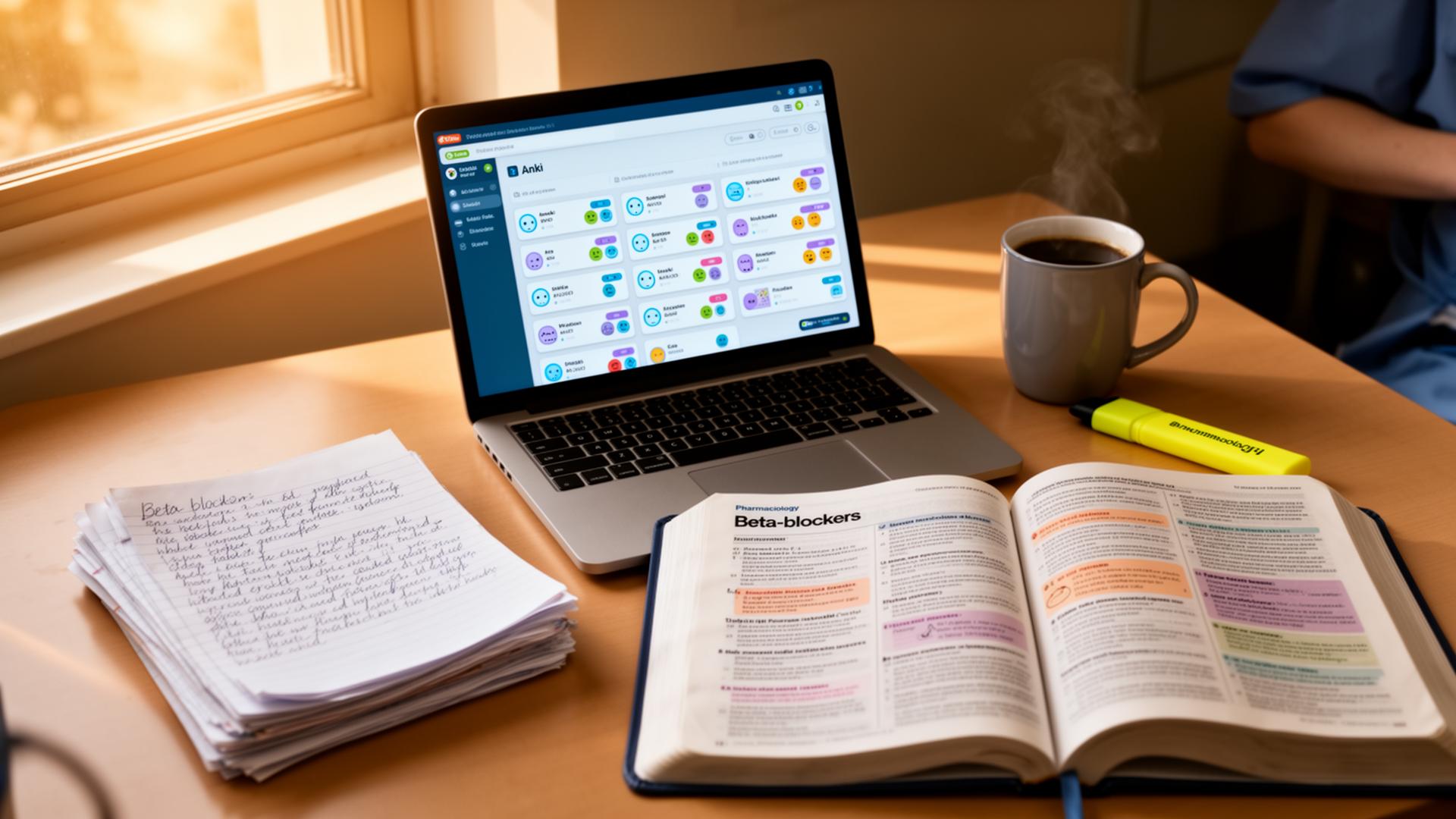
The fastest way to make flashcards with AI is to paste notes into ChatGPT, ask for cloze deletions with one fact per card, and import the output straight into Anki. The whole loop takes under five minutes per lecture. The hard part is not the generation, it is writing rules tight enough that the cards survive contact with spaced repetition. This guide is those rules, the prompt that bakes them in, and the deck-hygiene habits that keep a 2,000-card deck reviewable instead of abandoned.
What 'good' AI flashcards actually look like
A good AI-generated flashcard is atomic, recallable in under eight seconds, and tagged. Atomic means one fact, no compound questions. Recallable in eight seconds means the cloze hides a single high-information word, not a clause. Tagged means future you can filter your deck by topic without opening every card. Miss any of these and you have a flashcard you will leaf-press through on autopilot, which teaches you nothing and inflates your review count.
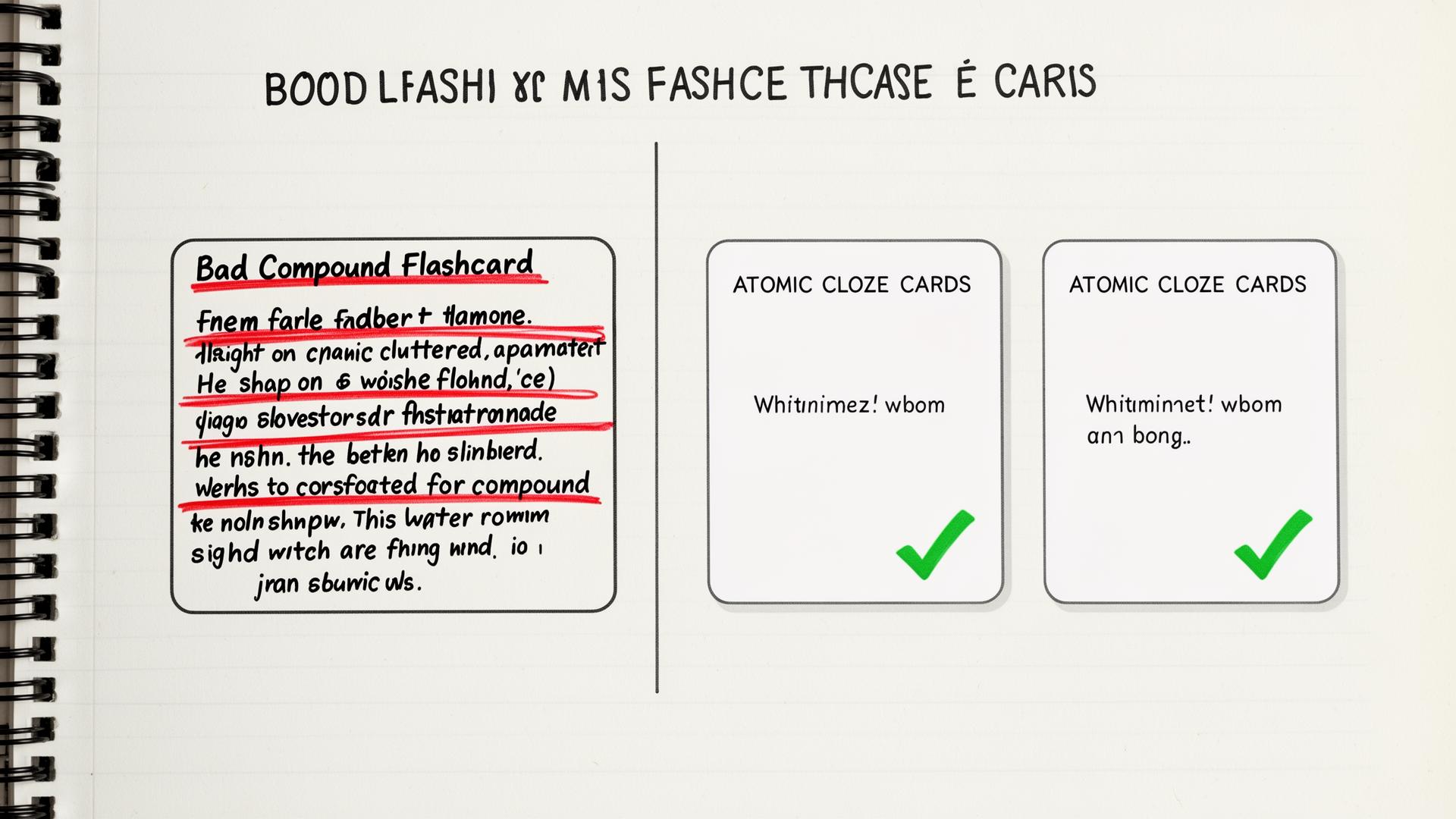
The most common failure mode is the compound card. 'The femoral nerve supplies quadriceps, sartorius, and pectineus' as a single cloze teaches you the order of the muscles, not which nerve supplies them. Three separate atomic cards beat it every time. The second most common failure is clozing the easy word. 'The {{c1::brain}} is in the skull' is not a flashcard, it is filler. Cloze the word a clinician would need to recall under pressure.
The four rules to bake into every prompt
1. One fact per card
Tell the model explicitly: 'no compound facts'. If a sentence in your notes contains three drugs, three side effects or three branches, instruct the model to split it into three cards. Anki's documentation calls this the Minimum Information Principle and it is the single rule most students skip.
2. Cloze by default, Q&A only for definitions
Cloze deletions are faster to write, faster to review, and let you hide multiple fields in one sentence (c1, c2, c3) without writing new cards. Reserve Q&A format for definitions or for cards where the answer is a list. Cloze handles everything else more efficiently.
3. Cloze the high-information word
The information value of a cloze equals how hard the word is to guess from context. 'The treatment for {{c1::anaphylaxis}} is 0.5 mg IM adrenaline' tests nothing because the dose gives it away. Flip it: 'The treatment for anaphylaxis is {{c1::0.5 mg}} IM {{c2::adrenaline}}.' That is two atomic clozes on one card, both testing what matters at 3am on a ward.
4. Tag at generation time, not after
Append tags inside the prompt: 'tag::cardiology::pharmacology::beta-blockers'. Anki uses :: as a tag hierarchy separator, so tagged cards become filterable by module, system and topic later. Nobody retrofits tags onto 600 cards. Generate them or lose them.
The prompt that bakes all four rules in
Paste your notes after the prompt below. The output imports cleanly into Anki via File then Import then Text Separated by Semicolon. Tweak the module and subtopic before each batch.
"Convert the following notes into Anki cloze deletions. Rules: (1) one fact per card, no compound facts. (2) Cloze the high-information word, the one a clinician would need to recall under pressure, not trivial words. (3) Use multiple clozes (c1, c2, c3) on a single sentence where it tests separate facts. (4) Append ' tag::medicine::[module]::[subtopic]' to each card. (5) Output one card per line, plain text, no numbering, no quotes, no commentary. Module: [paste]. Subtopic: [paste]. Notes: [paste]."
Which AI to use to generate the cards
ChatGPT, Claude and Gemini all follow the prompt above competently on the free tier. Claude (Sonnet 4.5 and above) tends to write the cleanest medical cards because it follows formatting instructions most strictly. ChatGPT is the most accessible, and the GPT-5 family handles longer note dumps without truncating output. Gemini is fine but more likely to add unrequested headers and emoji. Pick whichever you already have open.
| Model | Follows rules | Handles long notes | Free tier | Best for |
|---|---|---|---|---|
| Claude Sonnet 4.5 | Excellent | 200K tokens | Yes, limited daily | Cleanest cloze output |
| ChatGPT (GPT-5) | Very good | Long, with paid Plus | Yes | Default if you already pay $20 |
| Gemini 2.5 Pro | Good | Up to 1M tokens | Yes | Pasting whole lecture transcripts |
| NotebookLM | Good, grounded | Up to 50 sources | Yes | Cards cited to your PDFs |
All-in-one apps: convenient, but the algorithm matters
Knowt, Quizlet's AI features, RemNote and a growing list of newer apps generate and review in one place. Convenience is real. The trade-off is the spaced-repetition algorithm. Anki uses FSRS (Free Spaced Repetition Scheduler), which beat SM-2 by roughly 20 percent on workload-equivalent retention in the 2023 benchmark by Jarrett Ye, and SM-2 already beat most alternatives. Most all-in-ones use a simplified Leitner-style schedule, which is fine for languages and poor for high-volume medical content.
| Workflow | Generation speed | Algorithm | Cost | Retention |
|---|---|---|---|---|
| ChatGPT + Anki (FSRS) | Fast after one prompt | FSRS | Free (iOS $24.99) | Best |
| AnKing deck + ChatGPT for gaps | Slow setup, trivial after | FSRS | Free + sub | Best |
| Knowt | Fastest | Leitner-style | Free / $9.99 mo | Good |
| Quizlet AI | Fastest | Simplified SRS | $7.99 mo | Okay |
| RemNote | Fast | FSRS optional | Free / $8 mo | Very good |
What to feed the model, and what to keep out
- Your own lecture notes work best. They are already filtered for what your course examines.
- A NotebookLM study guide built from your slide deck. Source-grounded, so the model cannot drift.
- A specific textbook section, pasted in. Not the whole chapter.
- Guideline summaries from NICE, the BNF, or local trust protocols.
- Past-paper answers. Clozes built from worked rationales are unusually high yield.
- Avoid raw lecture transcripts. Filler sentences become filler cards. Summarise first, cloze second.
- Avoid 200-card sessions. Generate 30, audit the format, then scale.
- Avoid auto-import without reading. Bin bad cards at generation, not three weeks into review.
- Avoid patient identifiable data. Even anonymised case notes can breach GMC guidance if pasted into a consumer model. Strip names, MRNs and dates.
A worked example: generating beta-blocker cards
Take this note: 'Beta-blockers reduce mortality post-MI by 23 percent (ISIS-1, 1986). Bisoprolol and carvedilol are first line in heart failure with reduced ejection fraction. Avoid in severe asthma and decompensated heart failure.' Run it through the prompt above. The output is six atomic cards, not one paragraph card.
- Paste notes into ChatGPT with the prompt above (module: cardiology, subtopic: beta-blockers).
- Skim the output. Bin any compound clozes; reject any that hide trivial words.
- Copy the cleaned list into a .txt file, one card per line.
- In Anki: File then Import then choose Cloze note type then Import.
- Set new cards per day to 20 in deck options. Review daily, ideally at the same time.
- After two weeks, suspend cards you have failed three times running and rewrite them by hand.
Deck hygiene: the habit that keeps the system alive
Most students abandon Anki not because the cards are bad but because the queue becomes unmanageable. The single best preventative habit is a weekly 15-minute audit: open the browser, sort by 'lapses' descending, and rewrite or suspend the top 20. Cards that lapse repeatedly are almost always compound, ambiguous, or testing the wrong word. Rewriting them is faster than reviewing them forever.
The second habit is honesty on the Again / Hard / Good / Easy buttons. FSRS calibrates to your inputs. Press Good on cards you guessed and the algorithm will assume you knew them; the result is a schedule that feels easy until exam week, when the cards you faked come due in bulk. Press Again whenever recall took more than a few seconds. The short-term cost is more reviews this week. The long-term saving is enormous.
Sources
- Karpicke & Roediger — Critical Importance of Retrieval for Learning (Science, 2008)
- Anki Manual — Minimum Information Principle and card design
- Open Spaced Repetition — FSRS algorithm and benchmark
- ISIS-1 Collaborative Group — Beta-blockade in suspected MI (Lancet, 1986)
- NICE NG106 — Chronic heart failure in adults
- GMC — Confidentiality: good practice in handling patient information (2024)
- AnKing — Overview deck and add-on recommendations
Frequently asked questions
What is the best AI for making flashcards?
For medical retention, ChatGPT or Claude paired with Anki is the strongest combination. Claude Sonnet 4.5 follows formatting rules most strictly, ChatGPT is the most accessible, and Anki's FSRS algorithm outperforms the spaced-repetition schedulers built into all-in-one apps like Quizlet and Knowt by roughly 20 percent on equivalent workload.
How much does it cost to make flashcards with AI?
The full workflow runs free for most students. ChatGPT, Claude and Gemini all have generous free tiers; Anki is free on desktop, web and Android. The only paid component is AnkiMobile for iOS, a one-off $24.99 purchase. Paid AI tiers (ChatGPT Plus at $20 per month) help if you generate cards from very long notes daily, but are not required.
Can AI make Anki cards directly?
Not natively, but ChatGPT can output cloze-formatted text that imports into Anki in seconds. Generate one card per line with the prompt in this guide, paste into a .txt file, then in Anki choose File, Import, select the Cloze note type and confirm. Most students go from notes to reviewable deck in under five minutes per lecture.
Are AI flashcards as accurate as ones I write myself?
If you supervise the rules and reject bad cards at generation, yes. The act of writing cards manually has some learning value, but the bulk of retention comes from retrieval practice during review, not from authoring. AI lets you spend more time on the review and less on the typing, which on net improves outcomes.
How many AI flashcards should I make per day?
Generate fewer than you can. A sustainable rate is 20 to 40 new cards per day across all topics, matching Anki's default new-card limit. Generating 200 in one evening guarantees a review backlog you abandon by week three. Decks fail from queue overflow far more often than from card quality.
Will my medical school count AI flashcards as misconduct?
Using AI to generate revision flashcards from your own notes is not academic misconduct at any UK or US medical school as of 2026. Submitting AI-generated answers to assessed coursework is. The dividing line is whether the output is graded. Personal study aids, including AI-generated decks, sit firmly on the safe side.
Is AI flashcard generation safe with patient data?
No. Pasting patient-identifiable data into a consumer model (ChatGPT, Claude, Gemini) breaches GMC confidentiality guidance and most NHS information governance policies. Strip names, MRNs, dates and rare features that could re-identify a patient before generating cards from any case-based note. Use generic conditions, not specific patients.
What is better, Knowt or Anki with ChatGPT?
Knowt is faster to start and looks better, but its spaced-repetition algorithm is weaker. For a single module or short revision sprint, Knowt is fine. For four years of medical school content you need to keep alive until finals, Anki plus ChatGPT is the only combination with evidence behind its retention curve.
Try it
Sketch it. Angiosome renders it.
Angiosome turns rough medical sketches into clean, labelled, photoreal diagrams — grounded in your sketch, not invented by a model. Free to try.
Open Angiosome →