Comparison
BioRender alternatives in 2026: the honest comparison for medical and scientific illustration
Updated 1 June 2026 · 11 min read
BioRender alternatives matter in 2026 because BioRender's individual plan now starts at $39 a month ($468 a year) and its free tier explicitly bans publication use. The best alternative depends on what you draw: Angiosome for anatomy and procedures, Mind the Graph for cheap pathway figures, Inkscape plus SciDraw for open-source vector control, and BioRender itself only when your institution already pays. This guide ranks them honestly by use case, price, and licensing.
Why people look for BioRender alternatives
BioRender is the default for biological and medical figures because the icon library is enormous (more than 50,000 curated icons across 30+ disciplines as of 2026) and the drag-and-drop workflow is genuinely fast. It is also the most expensive tool in the category for individuals, ships with restrictive free-tier licensing, and renders every figure in an instantly recognisable house style. Reviewers can spot a BioRender figure across a conference room.
- Free tier explicitly prohibits use in publications, posters, theses, and any commercial output. Anything you make on free is for personal study only.
- Individual plans start at $39 a month billed annually ($468/year) for the Premium tier; Pro is $79/month. Academic and student pricing exists but varies by institution.
- Icon library doesn't always have the specific structure you need: a rare anatomical variant, a recently discovered receptor, a procedure-specific instrument layout.
- The aesthetic is recognisable. Every BioRender figure looks like a BioRender figure, which makes it harder for your work to stand out and easier for reviewers to assume it's templated.
- Lock-in: figures live inside BioRender's cloud editor. Export to PNG is fine; clean editable vector export to Illustrator or Inkscape is awkward.
The best BioRender alternatives by figure type
Pick by the figure you actually need, not by the brand. The four categories below cover roughly 95% of medical and life-science illustration jobs.
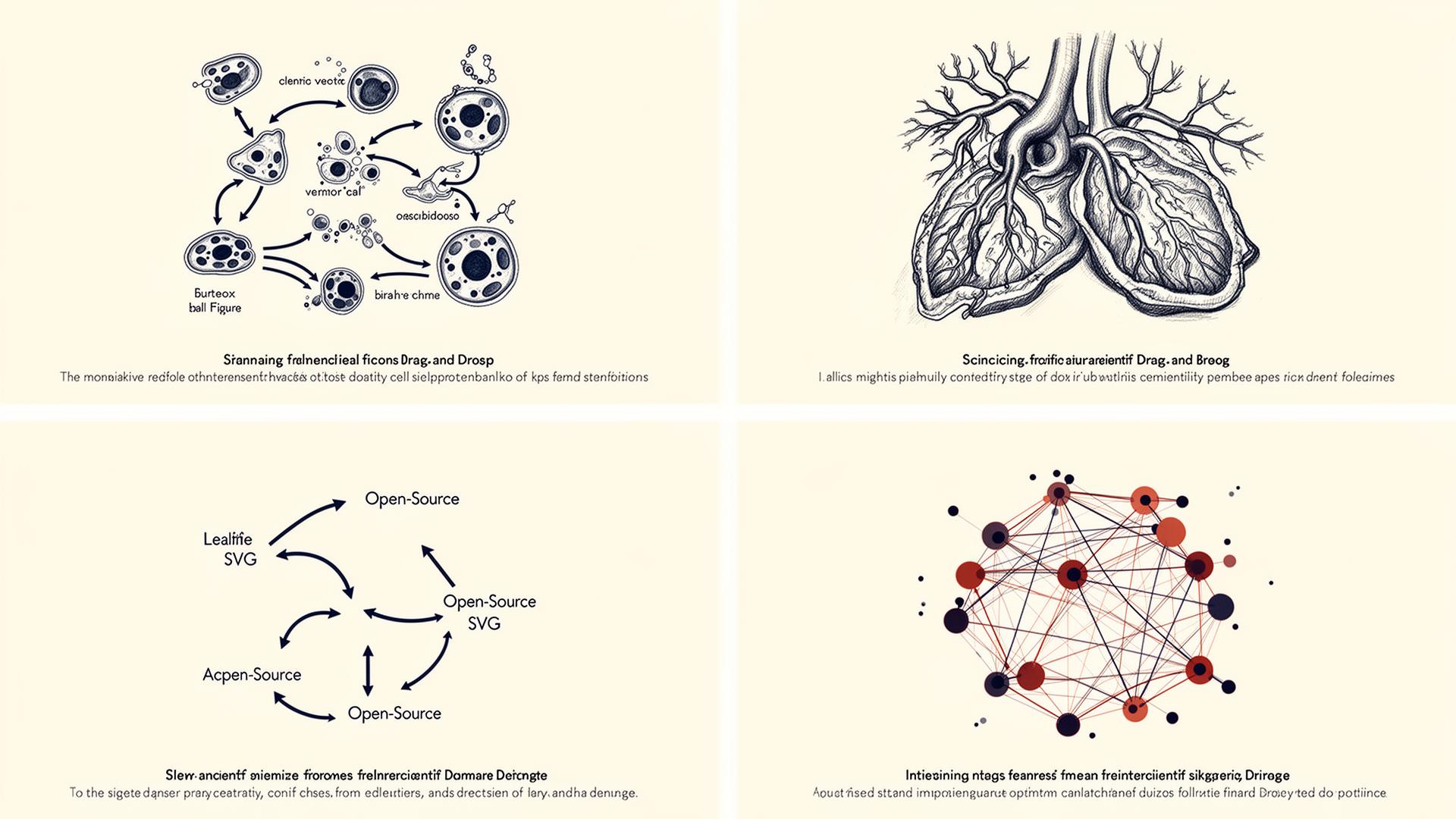
Sketch-first medical illustration: Angiosome
Angiosome is built around a different workflow than BioRender. Instead of dragging icons from a library, you sketch the structure (Apple Pencil, finger, mouse) and the model returns a clean labelled photoreal version constrained to your sketch. Strongest at anatomy, surgical sketches, pathology, and any structure where the exact configuration matters. Weakest at standardised molecular pathway diagrams. The free tier has no publication restriction on derived work, though you should always check current terms before submission.
Pathway and cell-biology figures on a budget: Mind the Graph
Closest direct competitor to BioRender. Smaller curated library (around 75,000 illustrations as of 2026), broader free tier, lower paid pricing (from $10/month annual, $25/month monthly). Same drag-and-drop paradigm, similar quality on common figures, weaker on niche specialties. The free tier does allow educational and publication use with attribution, which is the single biggest practical difference from BioRender.
Full control and zero recurring cost: Inkscape + SciDraw + Reactome
Inkscape is free open-source vector software. SciDraw (scidraw.io) and Reactome (reactome.org) publish thousands of open-licensed scientific icons. Combined, you get a publication-ready workflow with no recurring cost and full creative control. The trade-off is time: budget roughly three times longer per figure compared to a drag-and-drop tool while you learn Inkscape's layer model and path editor.
Pathway networks and systems biology: PathVisio, Cytoscape
Specialist tools for biological pathways and molecular networks, both free and open-source. Steeper learning curve than BioRender, much more powerful for actual network analysis. The right answer if pathway figures dominate your output and you need them tied to real data (Cytoscape integrates directly with KEGG, Reactome and STRING).
BioRender alternatives compared on price and publication licensing
Price is only part of the decision. The bigger trap is free-tier licensing: most students discover BioRender's publication ban only after submitting a poster. This table reflects current 2026 pricing and licensing terms; always re-check on the vendor's site before paying.
| Tool | Free tier | Cheapest paid | Free-tier publication use | Best for |
|---|---|---|---|---|
| BioRender | Limited icons, personal use only | $39/mo annual ($468/yr) | No | Pathway and cell biology figures (institution pays) |
| Angiosome | Generous, includes derived work | Paid tier varies | Yes (verify current terms) | Anatomy, procedures, sketch-first medical illustration |
| Mind the Graph | Limited downloads/month with attribution | $10/mo annual | Yes with attribution | BioRender-style figures on a budget |
| Inkscape + SciDraw | Fully free | Free | Yes (CC-BY where applicable) | Full control, journal-grade vector figures |
| PathVisio | Fully free | Free | Yes | Pathway diagrams tied to real data |
| Cytoscape | Fully free | Free | Yes | Molecular networks and systems biology |
| Canva | Generous | $15/mo Pro | Yes for most assets | Poster and slide layout, not illustration itself |
Which BioRender alternative to actually pick
Match the tool to the figure. Most clinicians and researchers end up using two: one drag-and-drop tool for pathways and one sketch-first tool for anatomy. Paying for both is still cheaper than BioRender's Pro tier.
- If most of your figures are pathway diagrams with named molecules and standard cell biology: Mind the Graph (cheapest) or BioRender (if your institution pays).
- If most of your figures are anatomy, procedures, pathology or surgical sketches: Angiosome.
- If you need full editorial control, journal-grade SVG, and have time: Inkscape with SciDraw and Reactome icons.
- If you're producing molecular networks tied to real data: Cytoscape or PathVisio.
- If you're building posters and slides where the diagrams come from elsewhere: Canva for layout, paired with a dedicated illustration tool.
| Figure type | Best BioRender alternative | Why |
|---|---|---|
| Anatomy and procedure diagrams | Angiosome | Sketch-first preserves your structure; library tools lack rare anatomy |
| Cell biology and signalling pathways | Mind the Graph | Closest BioRender clone, $10/mo annual, publication allowed with attribution |
| Journal-grade SVG you need to edit later | Inkscape + SciDraw + Reactome | Free, fully editable vector, no lock-in |
| Molecular networks tied to data | Cytoscape or PathVisio | Integrates with KEGG, Reactome, STRING databases |
| Pathology, histology annotation | BioRender Coloring or real images | AI safe on top of real microscopy |
| Posters and slide layout | Canva or LaTeX + your panels | Layout is not the illustration problem |
Publication use, attribution and AI disclosure
Most journals updated their AI and figure-use policies between 2023 and 2025. The ICMJE 2023 update requires authors to disclose any use of generative AI in figures and take full responsibility for accuracy. Nature does not currently accept fully AI-generated figures but allows AI-assisted refinement of human-drawn artwork. JAMA and BMJ allow disclosed use. Tools where you draw the structure and AI renders it (sketch-first) are generally treated more leniently because the scientific content originates with the author.
On attribution: Mind the Graph's free tier requires a small attribution mark on published figures. SciDraw and Reactome assets are typically CC-BY 4.0, meaning attribution is required but commercial use is allowed. BioRender's paid tiers give a publication licence with no attribution requirement. Angiosome's terms vary by tier and should be checked before submission. Always keep your source sketches and exported files in case a reviewer asks for provenance.
Editing BioRender figures outside BioRender
BioRender exports to PNG cleanly. SVG export exists on paid plans but the resulting file uses BioRender's internal structure and is awkward to edit in Illustrator or Inkscape: groups are deeply nested, fonts often need re-linking, and some icons rasterise. If you anticipate downstream editing in a vector editor, draft directly in Inkscape from the start, or accept that BioRender output is essentially final. This is one of the strongest practical reasons to consider an open-source pipeline for figures you'll iterate on across multiple papers.
Sources
- BioRender — Official pricing page — BioRender
- Mind the Graph — Official pricing — Mind the Graph
- Inkscape — Official site — Inkscape Project
- SciDraw — Open scientific drawings — SciDraw
- Reactome — Pathway database and icons — Reactome
- Cytoscape — Open-source network analysis — Cytoscape Consortium
- ICMJE — Recommendations on AI in scholarly publishing — ICMJE, 2023
- Nature — Editorial policy on generative AI in figures — Nature
Frequently asked questions
Is there a free alternative to BioRender for publication figures?
Yes. Mind the Graph's free tier allows publication use with a small attribution mark. Inkscape combined with SciDraw and Reactome icons is fully free and produces journal-grade SVG with CC-BY attribution where required. For sketch-first anatomy and procedure illustrations, Angiosome's free tier covers most student needs without the publication ban that BioRender's free tier carries.
Can I use BioRender's free tier in a publication or poster?
No. BioRender's free tier explicitly prohibits any publication, poster, thesis, or commercial use. You need a paid Premium ($39/month annual) or Pro ($79/month) licence to legally publish figures. Many students discover this only at submission; the simplest fix is to draft on the free tier for learning, then redo final figures on a paid plan or switch to a free-publication-friendly alternative.
What is the best AI alternative to BioRender in 2026?
For sketch-first medical illustration where you draw the anatomy and the AI renders and labels it, Angiosome is the clear answer. For AI-assisted icon search inside a BioRender-style library, Mind the Graph and BioRender's own AI search are roughly equivalent. Avoid generic image AI (DALL-E, Midjourney, Stable Diffusion) for any scientific figure because they hallucinate anatomy with full confidence.
Is BioRender worth $468 a year for a medical student?
Probably not, if you're paying personally. Most medical students produce fewer than ten formal figures a year, and those are almost always anatomy or procedure diagrams rather than pathway figures. A free Angiosome plan plus occasional Inkscape work covers that volume at zero cost. BioRender becomes worth it only when pathway figures dominate your output and your institution pays the academic rate.
Can I edit BioRender figures in Illustrator or Inkscape?
Technically yes, practically awkward. Paid BioRender plans export SVG, but the file uses deeply nested groups, often needs font re-linking and rasterises some icons. Light edits work; substantial redrawing does not. If you expect to iterate on a figure across multiple papers or grants, draft directly in Inkscape from the start, or accept BioRender's output as essentially final.
Which BioRender alternative is best for anatomy diagrams?
Angiosome. Anatomy is where BioRender's icon-library model is weakest because rare structures, anatomical variants, and procedure-specific layouts aren't in the library. Sketch-first tools let you draw the structure exactly as you need it, then handle the rendering and labelling. Generic image models (DALL-E, Midjourney) are unsafe for anatomy because they invent structures from text prompts with no anatomical grounding.
Do I need to disclose AI use in figures created with a BioRender alternative?
Yes, for most journals. The ICMJE 2023 update requires authors to disclose any generative AI used in figures. Nature does not accept fully AI-generated figures but allows AI-assisted refinement of human artwork. JAMA and BMJ allow disclosed AI use. Sketch-first tools where you draw the structure are generally treated more leniently than text-to-image generation, but always declare the specific tool in your methods section.
Can my supervisor or reviewer tell if a figure was made in BioRender?
Yes, easily. BioRender has an instantly recognisable house style (specific colour palette, icon proportions, drop-shadow defaults) that most senior researchers can identify at a glance. This isn't inherently a problem, but it does mean your figure carries an implicit 'made in BioRender' watermark. If you want figures that stand out, an open-source or sketch-first workflow gives you more visual differentiation.
Try it
Sketch it. Angiosome renders it.
Angiosome turns rough medical sketches into clean, labelled, photoreal diagrams — grounded in your sketch, not invented by a model. Free to try.
Open Angiosome →Keep reading
Pillar
AI Medical Illustration: The Honest Guide (2026)
Related field
AI Scientific Illustration: 2026 Researcher Guide
Pillar
Best AI Tools for Medical School (2026, Ranked)
How-to
How to Make Medical Diagrams with AI (2026)
Tool deep-dive
AI Presentations for Medical School: 2026 Guide
Comparison
Angiosome vs ChatGPT for Medical Illustration